



You have been lying to yourself for years now.
The calendar with no white space. The meeting that can’t happen without you. The Slack message at 7pm that begins sorry to bother you but or are you still around?
That addictive feeling that the show won’t go on without you. It feels like proof you are irreplaceable. It isn’t. You can be replaced within a blink of an eye.
In this essay I want to challenge what it really means to be irreplaceable. To feel it in your bones. Not to be considered as one — to actually be one.
Axel Honneth spent his career mapping why this matters so much to us. In The Struggle for Recognition, he argues that human identity is not self-generated — it’s confirmed through others. We need self-confidence, self-respect and self-esteem not as luxuries but as oxygen — these are conditions for a coherent self. As much as need to catch your breath. The hunger for recognition isn’t ego. It’s system architecture.
…which makes the trap so perfect. We don’t chase irreplaceability because we’re shallow. We chase it because being seen as essential is one of the oldest ways humans have located themselves in relation to others.
Your deep desire is not a problem. When you believe you get it, it becomes a problem.
Because in this very moment you think you've got it all: you secured recognition, you have earned it. So you stop burning the fuel that lead you there.
You start dramatically and miserably protecting it.
Bourdieu would call what most people are accumulating symbolic capital — visible markers of value that others can read without much effort: the packed schedule, the title, the prestigious role, the performance of being in demand. You name it.
As usual in the corporate game, the field rewards legibility. So people get legible. They optimize for the signals of worth rather than the substance of it.
The problem with symbolic capital is that it lives entirely in the audience. The moment the audience shifts — a reorg, a new technology, a company that grows past needing what you built — that capital evaporates.
Oops. Your meticulous digital validation falls like a house of cards.
You weren’t irreplaceable.
You were well-positioned in a field that no longer exists.
This is not a metaphor. This is what happened to an entire generation of middle managers in the last two years. Busy, recognized, essential — and then one Tuesday morning, a calendar invite with HR. Call yourself lucky if a human actually looked into your eyes to fire you. It had dignity at least.
Not because they failed. Because the field moved and they had spent so long becoming legible to it that they never built anything that could survive it leaving.
We are in 1733. Jean-Baptiste-Siméon Chardin painted a young man blowing a soap bubble.
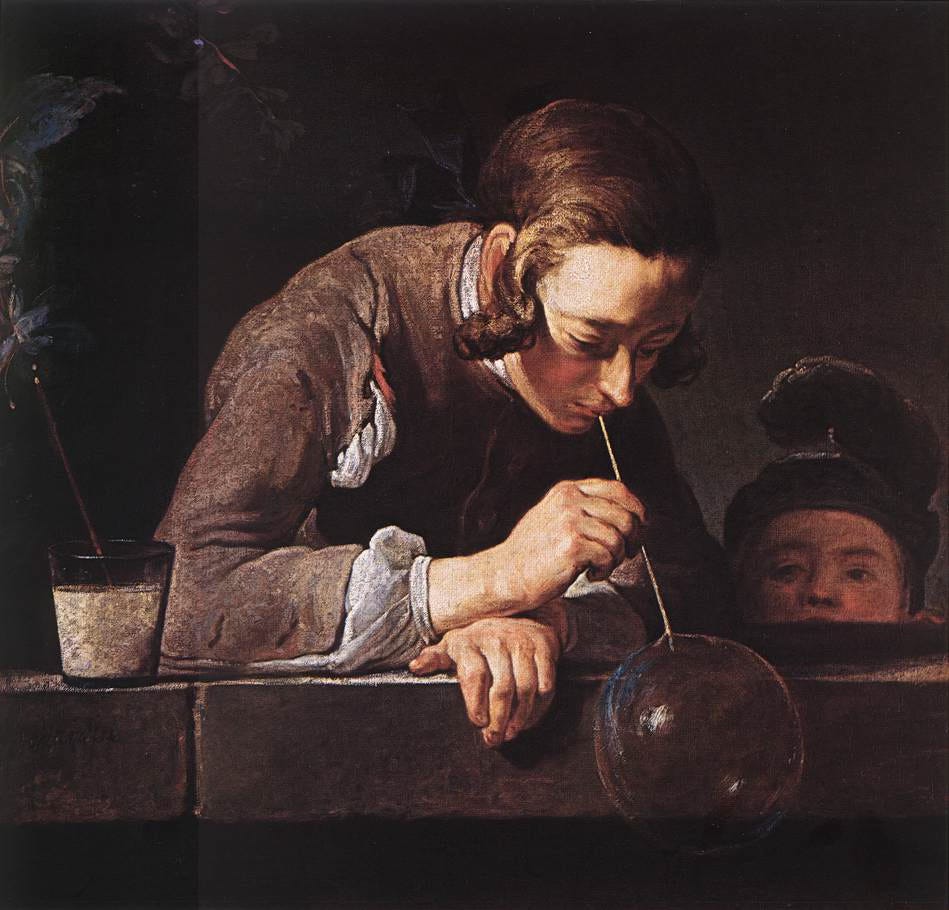
The boy does not know he is being watched. That is the painting.
He is not performing. He is just blowing the bubble. It will break. So what?
And that — the total absence of performance — is what makes him impossible to look away from. We have been watching for three hundred years.
The people who become genuinely irreplaceable look like this from the outside. Not performing significance. Just doing something real, with full attention, without checking whether anyone noticed.
Keep dancing when no one is watching.
The hardest turn in this argument is the one that sounds most like a self-help poster and is actually the opposite: the only recognition that compounds is your own.
Not self-congratulation.
Not affirmations.
Not tapping your own shoulder.
Honneth was right that we need recognition to form identity. But at a certain point, handing that job entirely to others doesn’t just make you anxious — it makes you replaceable. You become optimized for approval.
Legible, predictable, shaped by whoever’s watching. Boring.
Magnetic people are not trying to be magnetic. They have simply stopped needing you to confirm what they already know.
….and yet:
We are people.
We have to chase something.
We have to pretend.
We have to be silly.
We have to be unpredictable.
We have to blow bubbles knowing they will pop and blow another one anyway. That wildness — that refusal to be reasonable about what we pour ourselves into — is not a flaw in the system. It is the system. The boiling blood, the wild mind, the idea that wakes you up at 3am and won’t let you be sensible about it. That is not the enemy of irreplaceability. That is the only raw material it has ever been made from.
The trap is not the chasing. The trap is chasing the reflection of the chase — the stats, the recognition, the confirmation that someone noticed.
Vanity metrics. Performing the bubble instead of blowing it.
So the question — am I irreplaceable now? — is the wrong question. Not because irreplaceability doesn’t matter. But because the question keeps your gaze permanently outward, scanning for confirmation that never fully arrives, accumulating markers that other people can take away.
Irreplaceability is not a feeling. It’s a verdict. Guillotine. Decided by others, usually in your absence, often after it’s too late to be useful to you. Nobody — and I repeat, nobody — counts what you were worth while you're there. They count it after. The empty chair in the meeting. That work that now requires three people. The thing that quietly stops working and no one can explain why. Irreplaceability announces itself in absence, not presence.
You don’t get to know. You only get to do the work.
Stop asking if you’re irreplaceable. It’s a vanity metric dressed up as ambition.
Chase something. Pretend. Be silly. Be unpredictable. Let your blood boil and your mind go wild. Just stop watching yourself do it.
Take off your harness. If you can’t, just rip it off.
You still can, can’t you?
Fin
While you're here:
You Taste Like Average

There is more content being produced right now than at any point in human history.
Digital Sunburn

It’s 2026. Most professionals are well-acquainted with the “Digital Ascension.” We have all heard the arguments for…
Wow! I enjoyed this - it’s brilliant, thought provoking and you write so beautifully. I’ll never look at a bubble the same again! Throughout I was reminded of that quote “Cemeteries are full of indispensable men, and the world goes on quite well without them.”
This was such a brilliant read, Lucy. I loved the way you pulled apart the difference between being genuinely irreplaceable and being visibly needed, especially in a digital culture where validation can start to look a lot like recognition. It also made me think about when I lived and worked in Japan, and how important it was culturally to be seen as being 'busy' in an office, even when you weren’t. The image of performing the bubble instead of blowing it captures something subtle but very real, how easily the act of making something can get tangled up with the need to be seen making it. I’m really enjoying your work :)